Stop Predicting the Market: Build a Conditional Trading Plan
Build a trading plan around what price must do at a range boundary. Includes a historical Nasdaq example and clear reasons to wait.
3 min read
Conditional trading plans connect an action to something price must do first. Mark the area you care about, describe the response you need, and define where that idea fails. Until the condition appears, you have a scenario to watch.
This is the practical meaning of trading without predicting the next move. You can prepare for more than one outcome while keeping your decision tied to the chart in front of you.
Start with a boundary you can explain
Use the Stoic Range Model to mark the high, low and midpoint of a consolidation. Then describe where price sits relative to that range.
The boundary gives the plan a location. It does not supply an automatic entry. Price can sweep it and return, break through and hold, or cross it repeatedly without producing a useful trade.
If you cannot explain why a level matters, the first job is to improve the map.
Nasdaq example: two possible responses at the same level
In Stoic Edge Weekly 04, the Nasdaq discussion around 5:35 considers the 30,800 area. This was the chart context in the episode published October 12, 2026; it is not a current trade level.
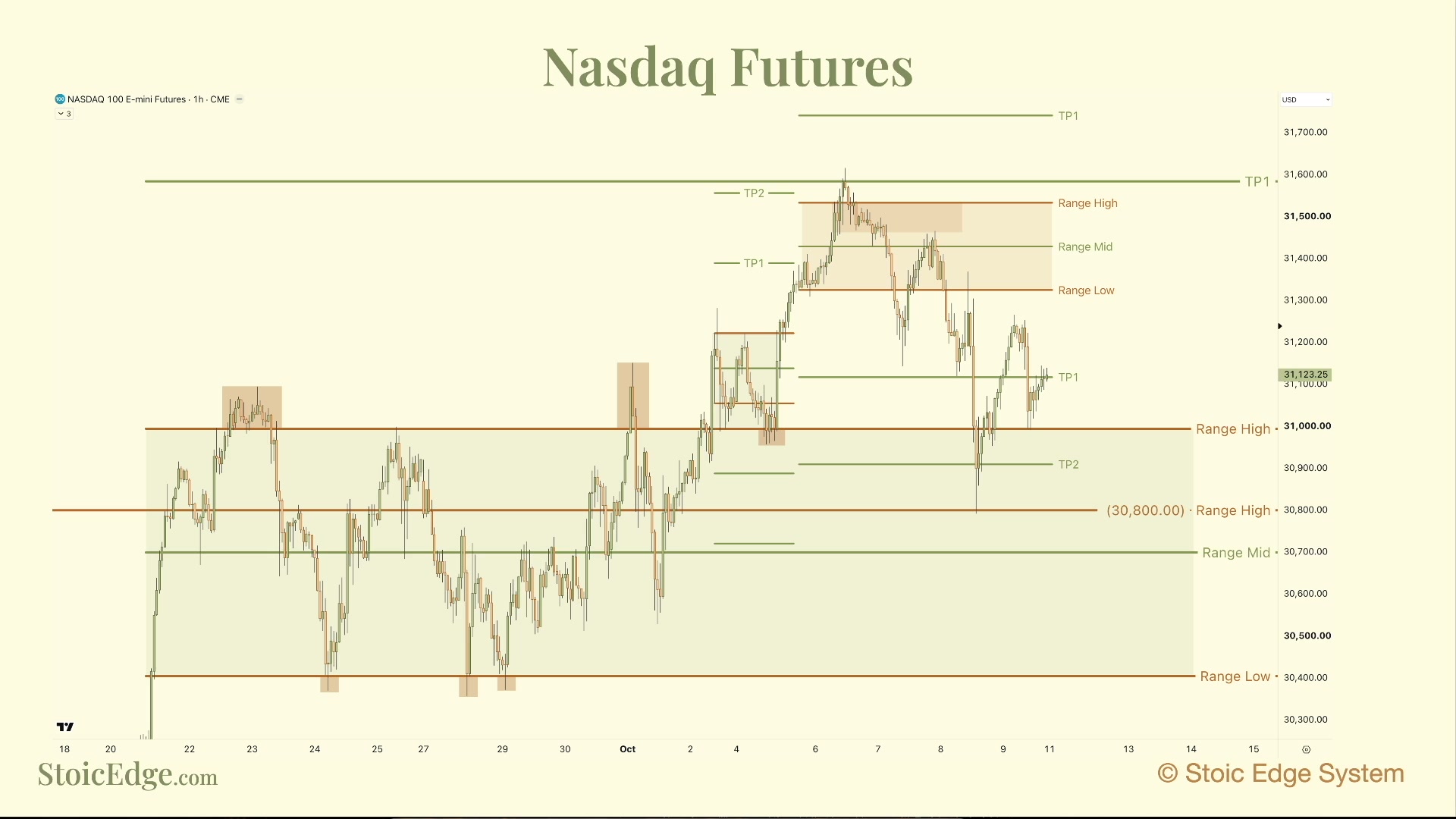
The discussion considers how price might respond to that boundary. Holding above it would leave one scenario in play. Rejecting it and returning below would change the map. The recording then looks at smaller ranges inside the larger structure.
Keeping both possibilities visible helps prevent a forecast from becoming a commitment. You still need to see the response and decide whether the available entry gives you acceptable risk.
Write the plan as conditions
For a boundary you are studying, write a short decision card:
- Location: the parent range and the boundary price is testing.
- Required response: a sweep and return inside, or a break and held retest outside.
- Entry condition: the evidence your chosen entry method requires after that response.
- Invalidation: the price or behavior that makes the idea wrong.
- Objective: the next relevant range level or expansion projection.
- Reason to wait: what would leave the setup unclear or the available room too small.
These are prompts for a plan. The specific levels and risk limits depend on the market and your tested rules.
Separate the parent range from the entry chart
Smaller ranges can form near the edge of a larger one. Its breakout may help you time an entry, but the parent boundary can still be close enough to matter.
Keep both scales visible. Otherwise, a clean local pattern can hide the fact that price is already approaching the larger objective.
The break-and-retest guide shows this relationship in an earlier Nasdaq walkthrough.
Make room for an unclear chart
Around 8:56 in the October 12 episode, the discussion acknowledges that Nasdaq may simply be unclear. Choosing not to trade that chart is a complete response.
If neither scenario has developed, leave both unconfirmed. If price changes the structure, update the plan before taking risk. The forecast you wrote yesterday does not obligate you to trade today.
After the session, record which condition appeared, what you did, and whether the decision followed the plan. Keep the market outcome separate from the quality of your execution: a profitable result alone cannot establish that the process was sound.
Watch the walkthrough
Watch the full episode and selected moments, or open the Nasdaq discussion at 5:35 on YouTube.
Then use the range target guide to map the objective and the stop-loss guide to define invalidation. The examples explain a planning process; they do not guarantee the next price move.
Stoic Edge provides education. Historical examples and practice exercises do not establish future performance.
Watch the source videos
Study the original demonstrations alongside this guide. Recording dates and historical context appear on each video page.
Put the Lesson Into Practice
Study the course, keep notes and review trades in Stoic Journal beta, and learn alongside the Stoic Traders community.
Compare monthly and yearly course access before joining on Skool. Compass is included while monthly membership is active; yearly Premium includes lifetime course and Compass access. You can also get Stoic Edge Compass separately.
