How to Control Emotions While Trading (Stoic Method)
Fear and greed destroy more accounts than bad strategies. Here is the Stoic method for removing emotional decisions before the market opens.
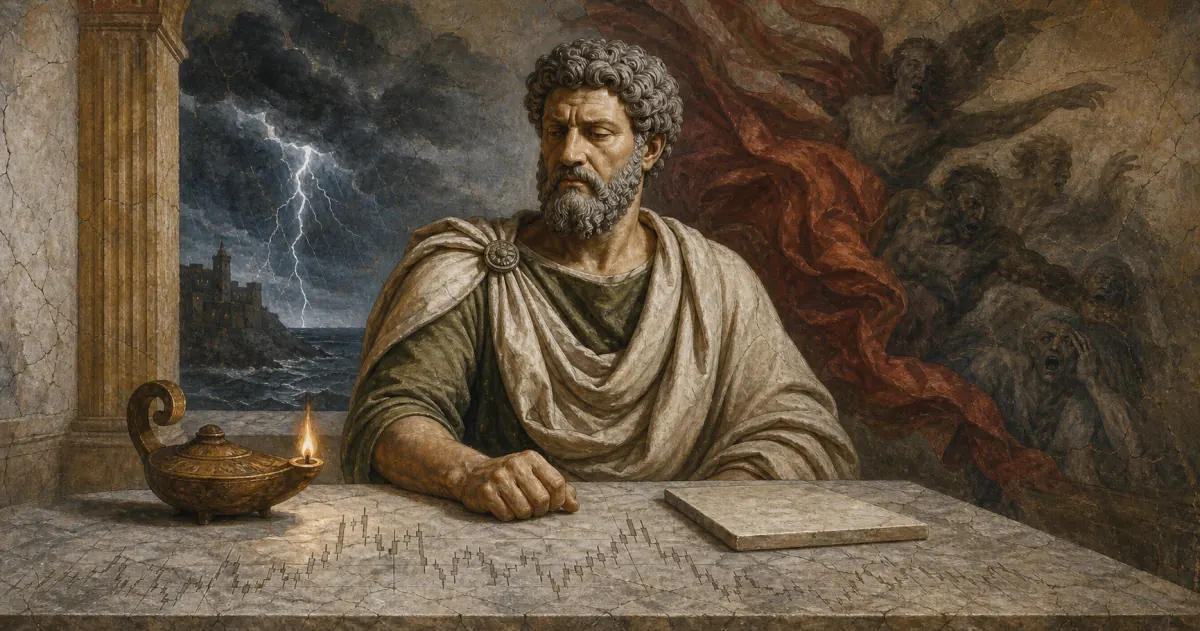
You had the perfect setup.
Entry was clean. Stop was placed. Target was clear. You had been waiting for this exact trade all morning.
Then the candle went red. Just a small pullback, totally normal. Your stop was still eight points away.
But your chest tightened. Your hand moved to the mouse. And before your brain could catch up, you closed the position. Breakeven minus commissions.
Ten minutes later, price hit your target. Exactly where you said it would.
You were right about the trade. You were wrong about yourself.
This happens to every trader. Not once, constantly. The setup works. The system works. But the person operating the system panics, hesitates, or overreacts at the worst possible moment.
The problem is not your strategy. The problem is your nervous system.
Key Takeaways:
- Your fear center reacts five times faster than your rational brain, which is why you break rules even when you know better.
- The only way to remove emotional decisions is to make all decisions before the market opens, not during the session.
- Accept the loss in full before entry so your brain has nothing to panic about mid-trade.
- One trade is a rounding error in your career. Stop giving individual results that much power.
Why Your Brain Works Against You
Your amygdala, the threat-detection center of your brain, cannot tell the difference between a losing trade and a physical attack. Both trigger fight or flight.
In trading, fight looks like revenge trading. Flight looks like closing early. Both are your nervous system trying to eliminate the threat. Both cost you money.
This is not a character flaw. It is neuroscience. The traders who last are not the ones who feel less fear. They are the ones who build a system that makes fewer decisions when fear is running.
The Stoic Method: Pre-Decide Everything
The Stoic solution to emotional trading is simple: make all meaningful decisions before the market opens.
The night before, you mark three levels: previous daily high, previous daily low, previous daily close. You write down your plan. If price reaches PDH and shows a reversal setup, you look for the short. If price sweeps PDL and recovers, you look for the long.
You define your stop location before the session. You define your target. You define exactly what you need to see to enter.
When the market opens, there are no decisions left to make. Your job is to execute what you already decided. That is it.
The amygdala hijacks decisions. It cannot hijack the execution of a pre-made plan as easily.
The Pre-Trade Checklist
Run this before every session:
1. Where are the three levels? PDH, PDL, and PDC. Marked before the open. No skipping.
2. What is the plan at each level? If price reaches PDH, am I looking for a reversal or a continuation? What do I need to see? Write it down.
3. Where does the stop go? Your stop location is decided before you enter. Not while you are watching the candles. Not after entry. Before.
4. What is the target? Write it down. The next significant level. Hold until it is reached or until the trade is clearly wrong.
5. What is on the news calendar? NFP, FOMC, CPI. Know the times. Do not enter before major news. Wait for the spike to pass.
If you cannot answer all five before the session, you are not ready to trade.
Accept the Loss Before Entry
The most powerful thing you can do before placing any trade is accept the loss in full.
Before you enter, ask: if this trade goes to my stop immediately, is that amount acceptable? If yes, enter. If no, reduce size until it is acceptable, then enter.
Once you have accepted the full stop amount, the position cannot hurt you emotionally. The worst case is already processed. All that is left is to follow your exit rules.
This eliminates the mid-trade panic that causes early exits and rule violations. You already accepted the worst outcome. There is nothing left to fear.
One Trade Is a Rounding Error
Most of the emotional damage in trading comes from giving individual trades too much weight.
One loss becomes a bad day. A bad day becomes a crisis. A crisis becomes revenge trading. That spiral is responsible for more blown accounts than any bad strategy.
The Stoic Trader thinks in careers, not candles.
If you take 250 trading days per year, one trade represents 0.4% of your annual sample. A single loss, no matter how painful it feels, is statistically irrelevant to your long-term outcome.
The traders who build real accounts are the ones who absorbed this truth and stopped letting individual results control their behavior.
The System Is Designed to Remove Decisions
The deeper purpose of the Stoic system is not just to find good setups. It is to structure your day so that your emotional brain has as few opportunities as possible to hijack your execution.
Three levels. Two setups. Pre-made plan. Predefined stop and target. No decisions when the market is moving.
When you have a real system, trading becomes boring. And boring is the goal.
Boring means no drama. No impulse entries. No revenge trades. No panic exits. Just the process, repeated.
The traders who have mastered this do not have better chart-reading skills than you. They have a better relationship with uncertainty. They accept that they will be wrong sometimes, that the loss is part of the business, and that the only thing they can control is whether they followed the plan.
That acceptance is what the 90-Day Challenge is built to develop. The foundation is three levels and two setups. The result is a different kind of trader.
If you want to build that, the membership is where the real work happens. The foundation is three levels and a pre-made plan. The deeper layer is knowing which sessions, which setups, and which levels deserve conviction, and that read comes from the higher-timeframe context inside Stoic Traders. The daily War Map, the graded setups, the templates. That is what turns discipline into edge.